Article by Kellie Hayden
Published on May 18, 2009
Strategy number 5 – Keep the lesson moving. If you have a forty-five minute period, plan three different activities. Try to get them up out of their seats at least once during the class period. Those students with pent up energy will thank you for it.
Strategy number 4 – Don’t lecture for the whole period. Students who are actively engaged in a learning activity are generally not disrupting the class. Hands-on activities work great for vivacious classrooms.
Strategy number 3 – Talk to your students. If you see them in the hall, in the cafeteria or at the grocery store, ask them how they are. If you see a student in the local newspaper, congratulate them. If they do something nice, tell them that you appreciate their kindness. This lets them know that you really do care about them.
Strategy numbers 2 -- When students are being disruptive by talking, poking, pulling or crumpling paper, go stand by them. This works best with boys. I have taught from the back of the room by the orneriest boys. This sends them a direct message to stop what they are doing. Most of the time they stop and get back to work.
Strategy number 1 – When you have stood by the student, talked to the student and kept them busy with lessons, and they still are disruptive, take them in the hallway. Ask them, “Are you OK?” It has been my experience that they crumble and tell you that they had a fight with their parents, didn’t get up on time or are having other issues. If they are defiant, send them on to the principal. In the last five years, I have sent very few kids to the principal’s office for classroom disruptions.
Kids are kids. If they are not actively engaged in the lesson, they will become actively engaged in something else – disruptive behavior. Try these five strategies to keep them learning.
Wednesday, May 20, 2009

Wednesday, May 13, 2009
Web 2.0 for the Classroom Teacher
Here is an excellent resource:
http://www.kn.att.com/wired/fil/pages/listweb20s.html
http://www.kn.att.com/wired/fil/pages/listweb20s.html
Monday, April 27, 2009
Special Education in the Science Classroom:
Here is a really good artical on teaching science.
http://www.glencoe.com/sec/teachingtoday/subject/special_ed.phtml
http://www.glencoe.com/sec/teachingtoday/subject/special_ed.phtml
Tuesday, April 21, 2009
Setting Up Your Portfolio Matrix
1. Choose your first piece of work. ex. lesson plan
2. Put that piece of work behind Tab 1.
3. Look at the RIBTS that piece of work (lesson plan) addresses: RIBT 1.2 & 5.1
4. On your matrix beside RIBT 1.2 in the Evidence Box you write Lesson Plan, the name of the assignment, then the number of the Tab. Since it is the first piece, it will be behind Tab 1.
5. Since the lesson plan also addresses RIBT 5.1, beside that standard in the matrix you also write Lesson Plan and in the Tab box write number 1.
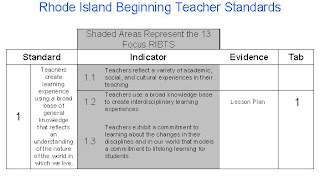
Every assignment has a tab.
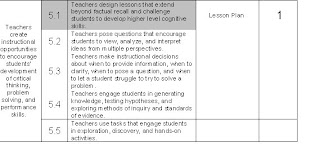
2. Put that piece of work behind Tab 1.
3. Look at the RIBTS that piece of work (lesson plan) addresses: RIBT 1.2 & 5.1
4. On your matrix beside RIBT 1.2 in the Evidence Box you write Lesson Plan, the name of the assignment, then the number of the Tab. Since it is the first piece, it will be behind Tab 1.
5. Since the lesson plan also addresses RIBT 5.1, beside that standard in the matrix you also write Lesson Plan and in the Tab box write number 1.

Every assignment has a tab.

Tuesday, April 14, 2009
Creating Folders and Organizing Assignments and Artifacts in Tk20
By now you have many assignments and artifacts in Tk20 from fall 2008 through winter and now spring 2009. You can organize these assignments and artifacts into folders. It will make it easier for you to locate and organize and use the assignments you need now. Here is the procedure:
Creating folders
1. Click Courses on the Main Tabs.
2. Click on Assignments in the left side menu.
3. Then click on Edit Folders on left side menu.
4. On the next screen click on the add new button-a field will appear for you to write a name.
5. Create a name for your new folder-suggestion: Fall 2008.
Click the add new button again to create another folder-suggestion: Winter 2008-2009.
Organzing Assignments and Artifacts
6. Then click on coursework.
7. Next click in all the boxes that have fall assignments.
8. Then in the upper right hand side of the page click on the drop down menu that says Move to Folder and select Fall 2008 folder. All of the fall assignments will be moved to this folder.
9. Next click on the box before all the assignments for the winter.
10. Then in the upper right hand side of the page click on the drop down menu that says Move to Folder and select winter 2008-2009 folder. All of the winter assignments will be moved to this folder.
You can follow the same procedure to organize your artifacts.
Creating folders
1. Click Courses on the Main Tabs.
2. Click on Assignments in the left side menu.
3. Then click on Edit Folders on left side menu.
4. On the next screen click on the add new button-a field will appear for you to write a name.
5. Create a name for your new folder-suggestion: Fall 2008.
Click the add new button again to create another folder-suggestion: Winter 2008-2009.
Organzing Assignments and Artifacts
6. Then click on coursework.
7. Next click in all the boxes that have fall assignments.
8. Then in the upper right hand side of the page click on the drop down menu that says Move to Folder and select Fall 2008 folder. All of the fall assignments will be moved to this folder.
9. Next click on the box before all the assignments for the winter.
10. Then in the upper right hand side of the page click on the drop down menu that says Move to Folder and select winter 2008-2009 folder. All of the winter assignments will be moved to this folder.
You can follow the same procedure to organize your artifacts.
Monday, April 6, 2009
Wednesday, April 1, 2009
First Formal Review of Portfolio
Here is a check list that will be used for your first portfolio review. The matrix were emailed to you. You will need them. Print them and put them in your portfolio.
I wish we were using electronic portfolios, but we are not there yet. It might still happen before the end of your program.
_____ Sufficient progress towards meeting the thirteen pre-student teaching FOCUS RIBTS
_____ Standard indicator(s) are numbered and written
_____ CEC standards are numbered and written
_____ Diversity standards are numbered and written
_____ Description of evidence is in paragraph form and explained completely
_____ Narrative for each indicator/standard demonstrates an understanding of the connection between the competencies required within the standard and how the evidence submitted reflects the candidate’s understanding gained through experience and study.
_____ Original work with professor’s comments
_____ Format
_____ Appearance
_____ Name on spine of binder
_____ Typewritten
_____ Dividers
_____ No page protectors
_____ Matrix
_____ No spelling errors
_____ No punctuation errors
_____ No grammatical errors
I wish we were using electronic portfolios, but we are not there yet. It might still happen before the end of your program.
_____ Sufficient progress towards meeting the thirteen pre-student teaching FOCUS RIBTS
_____ Standard indicator(s) are numbered and written
_____ CEC standards are numbered and written
_____ Diversity standards are numbered and written
_____ Description of evidence is in paragraph form and explained completely
_____ Narrative for each indicator/standard demonstrates an understanding of the connection between the competencies required within the standard and how the evidence submitted reflects the candidate’s understanding gained through experience and study.
_____ Original work with professor’s comments
_____ Format
_____ Appearance
_____ Name on spine of binder
_____ Typewritten
_____ Dividers
_____ No page protectors
_____ Matrix
_____ No spelling errors
_____ No punctuation errors
_____ No grammatical errors
Thursday, March 26, 2009
Glossary of Math Teaching Strategies
Accelerated or individualized math: a system of having students work at different levels individually in one classroom. They progress by passing tests for each unit and move at their own pace.
Adjusted speech: teacher changes speech patterns to increase student comprehension. Includes facing the students, paraphrasing often, clearly indicating most important ideas,limiting asides, etc.
Curriculum Based Probe: having students solve 2-3 sheets of problems in a set amount of time assessing the same skill. Teacher counts the number of correctly written digits,finds the median correct digits per minute and then determines whether the student is at frustration, instructional, or mastery level.
Daily re-looping of previously learned material: A process of always bringing in previously learned material to build on each day so that students have a base knowledge to start with and so that learned structures are constantly reinforced.
Ecological approach/generate data from real life experiences to use in class: involves all aspects of a child’s life, including classroom, family, neighborhood, and community, in teaching the child useful life and educational skills.
Explicit timing: timing math seatwork in 30-minute trials that are used to help students become more automatic in math facts and more proficient in solving problems. Teacher compares correct problem per minute rate. Used to recycle materials and concepts.
Explicit vocabulary building through random recurrent assessments: Using brief assessments to help students build basic subject-specific vocabulary and also gauge student retention of subject-specific vocabulary. This list of teaching strategies and activities was developed out of a focused brainstorming process conducted with general education, special education and English as a Second Language teachers in Minnesota during the 2001-2002 school year. The list represents strategies and activities that teachers report that they use(or have used)to teach middle school-aged English language learners with disabilities. In most cases, the words that the teachers used to describe a strategy or activity are what is presented here in the glossary. A few of the strategies listed have definitions taken from professional literature. In the 2004-2005 school year NCEO will conduct single-case studies with ELLs who have disabilities that will be based on selected strategies from this list.
Graphic organizers: visual displays to organize information into things like trees,flowcharts, webs, etc. They help students to consolidate information into meaningfulwhole and they are used to improve comprehension of stories, organization of writing,and understanding of difficult concepts in word problems.
Model-lead-test strategy instruction (MLT): 3 stage process for teaching students toindependently use learning strategies: 1) teacher models correct use of strategy; 2)teacher leads students to practice correct use; 3) teacher tests’ students’ independent useof it. Once students attain a score of 80% correct on two consecutive tests, instruction onthe strategy stops.
Monitoring of progress through group and individual achievement awareness
charts: Using charts to build awareness and motivation of progress for students. The emphasis here is on progress so even students working at different levels can chartsignificant gains. Native language support: providing auditory or written content input to students in their native language.
Problem solving instruction: explicit instruction in the steps to solving a mathematical or science problem including understanding the question, identifying relevant and irrelevant information, choosing a plan to solve the problem, solving it, and checking answers.
Reciprocal peer tutoring (RPT) to improve math achievement: having students pair,choose a team goal to work toward, tutor each other on math problems, and then individually work a sheet of drill problems. Students get points for correct problems and work toward a goal. Reinforcing math skills through games: Using games to follow-up a lesson in order to reinforce learned skills and use the skills in another context.
Response journal: Students record in a journal what they learned that day or strategies they learned or questions they have. Students can share their ideas in the class, with partners, and with the teacher.
Student developed glossary: Students keep track of key content and concept words and define them in a log or series of worksheets that they keep with their text to refer to.
Students generate word problems: Have students create word problems for a specific math skill. Through the construction of a problem the students learn what to look for when solving word problems they are assigned. Tactile, concrete experiences in math: Using three dimensional objects in math instruction such as geometrical shapes, coins, or blocks used to form various geometrical shapes.
Think-alouds: using explicit explanations of the steps of problem solving through teacher modeling metacognitive thought. Ex: Reading a story aloud and stopping at points to think aloud about reading strategies/processes or, in math, demonstrating the thought process used in problem solving.
References:
Celce-Murcia, M. (Ed.). Teaching English as a second or foreign language. 3rd Ed.
Boston: Heinle & Heinle.
Chamot, A.U. & O’Malley, J.M. (1994). The CALLA handbook: Implementing the
cognitive academic language learning approach. New York: Addison-Wesley.
ERIC Digest. (1993). Teaching limited English proficient students to understand
and use mathematics. ERIC DIGEST 70. (EDO-UD-91-0). Document accessed on the web:
http://eric.web.tc.Columbia.edu/digests/dig70.html on February 23, 2001.
Laturnau, J. (2001, June). Standards-based instruction for English language
learners. PREL Briefing Paper (PB0102). Honolulu, HI: Pacific Resources for Education
and Learning.
Meyen, E.L., Vergason, G.A., & Whelan, R.J. (1996). Strategies for teaching
exceptional children in inclusive settings. Denver: Love Publishing Co.
Rathwon, N. (1999). Effective school interventions: strategies for enhancing
academic achievement and social competence. New York: The Guilford Press NYC.
Smith, T. et al. (1995). Teaching children with special needs in inclusive settings.
Allyn and Bacon.
Tuesday, March 17, 2009
Thursday, March 12, 2009
Program Outcomes
For over a year the MAT faculty and staff have been in the process of creating a conceptual framework. The conceptual framework serves as the guiding structure to articulate the multiple dimensions of the MAT teacher education program. The creation of this document consists of multiple steps. Here are some of them:
•Review our mission and vision
•Review our philosophies and goals
•Determine the knowledge bases in the program with regard to theories, research, and practice
•Determine candidate proficiencies
•Align the above with local and national standards
•Determine, select and create assessments.
All of these aspects were discussed among the staff and brought to the faculty for further discussion and analysis. Last summer the faculty and staff worked with well known researcher Marilyn Cochran-Smith from Boston College to further guide, clarify, and validate our work. The process was time consuming, but it was very worthwhile. All of this work has led to a shared vision of the curriculum that is coherent and meaningful.
The most important result that has occurred in this process has been the creation of four program outcomes. It is important for you to get acquainted with them. Please read them and answer the questions below.
I. Candidates have knowledge of diverse learners and are responsive to their developmental and social contexts.
All candidates will:
•design appropriate research-based learning experiences that reflect understanding of developmental stages and the way each student learns;
•develop appropriate learning experiences that reflect an understanding of the language and culture of others;
•establish a safe environment where each student is accepted and where curiosity and risk taking are valued;
•use student’s prior knowledge to make personal connections to subject matter.
II. Candidates have the knowledge of teaching as intricate and collaborative work.
All candidates will:
•set expectations for learning, model learning strategies, and provide constructive feed-back;
•create opportunities for students to self-assess;
•use a variety of explanations and multiple representations of concepts that help students develop conceptual understanding;
•deliver effective instruction based on research to keep students challenged, focused and accountable;
•revise instructional strategies both long range and moment to moment; as necessary;
•use technological advances to enrich instructional practices;
•collaborate and work in partnership with peers, schools, families, other professionals and agencies in supporting student learning.
III. Candidates will know their subject matter and how to teach it in light of the social purposes of education.
All candidates will:
•have a deep understanding of the history, structure and real-world purposes of education;
•use research in the disciplines that they teach.
•incorporate local, state and national standards curriculum and instruction
•balance breadth and depth, incorporate affective and cognitive goals for learning.
•know professional, educational, legal and ethical responsibilities to students and their families.
•teach specific subject matter in ways that are universally accessible to all students.
IV. Teacher candidates will become reflective teacher researchers who will use assessment and contextual data to inform practice.
All candidates will:
•continuously use insights from assessment for instructional and programmatic changes over time;
•design and/or select assessments that embody standards and goals using the backward design process;
•select and/or design tools that are most useful for assessing student competence;
•analyze and synthesize data from multiple sources to identify strengths and needs at the classroom, school and district level to inform instruction;
•provide data-based accommodations and modifications addressing academic and contextual variables that may influence students’ performance.
These outcomes are our beliefs and thus the foundation of the MAT program.
Why do you think we chose these outcomes? What do these mean to you?
Further explanation these ourcomes will occur in later posts.
•Review our mission and vision
•Review our philosophies and goals
•Determine the knowledge bases in the program with regard to theories, research, and practice
•Determine candidate proficiencies
•Align the above with local and national standards
•Determine, select and create assessments.
All of these aspects were discussed among the staff and brought to the faculty for further discussion and analysis. Last summer the faculty and staff worked with well known researcher Marilyn Cochran-Smith from Boston College to further guide, clarify, and validate our work. The process was time consuming, but it was very worthwhile. All of this work has led to a shared vision of the curriculum that is coherent and meaningful.
The most important result that has occurred in this process has been the creation of four program outcomes. It is important for you to get acquainted with them. Please read them and answer the questions below.
I. Candidates have knowledge of diverse learners and are responsive to their developmental and social contexts.
All candidates will:
•design appropriate research-based learning experiences that reflect understanding of developmental stages and the way each student learns;
•develop appropriate learning experiences that reflect an understanding of the language and culture of others;
•establish a safe environment where each student is accepted and where curiosity and risk taking are valued;
•use student’s prior knowledge to make personal connections to subject matter.
II. Candidates have the knowledge of teaching as intricate and collaborative work.
All candidates will:
•set expectations for learning, model learning strategies, and provide constructive feed-back;
•create opportunities for students to self-assess;
•use a variety of explanations and multiple representations of concepts that help students develop conceptual understanding;
•deliver effective instruction based on research to keep students challenged, focused and accountable;
•revise instructional strategies both long range and moment to moment; as necessary;
•use technological advances to enrich instructional practices;
•collaborate and work in partnership with peers, schools, families, other professionals and agencies in supporting student learning.
III. Candidates will know their subject matter and how to teach it in light of the social purposes of education.
All candidates will:
•have a deep understanding of the history, structure and real-world purposes of education;
•use research in the disciplines that they teach.
•incorporate local, state and national standards curriculum and instruction
•balance breadth and depth, incorporate affective and cognitive goals for learning.
•know professional, educational, legal and ethical responsibilities to students and their families.
•teach specific subject matter in ways that are universally accessible to all students.
IV. Teacher candidates will become reflective teacher researchers who will use assessment and contextual data to inform practice.
All candidates will:
•continuously use insights from assessment for instructional and programmatic changes over time;
•design and/or select assessments that embody standards and goals using the backward design process;
•select and/or design tools that are most useful for assessing student competence;
•analyze and synthesize data from multiple sources to identify strengths and needs at the classroom, school and district level to inform instruction;
•provide data-based accommodations and modifications addressing academic and contextual variables that may influence students’ performance.
These outcomes are our beliefs and thus the foundation of the MAT program.
Why do you think we chose these outcomes? What do these mean to you?
Further explanation these ourcomes will occur in later posts.
Tuesday, March 3, 2009
Subscribe to:
Posts (Atom)